With AI, Could We Lose the Art in Culinary Arts?
If we aren’t careful, artificial intelligence could take a big byte out of our craft.
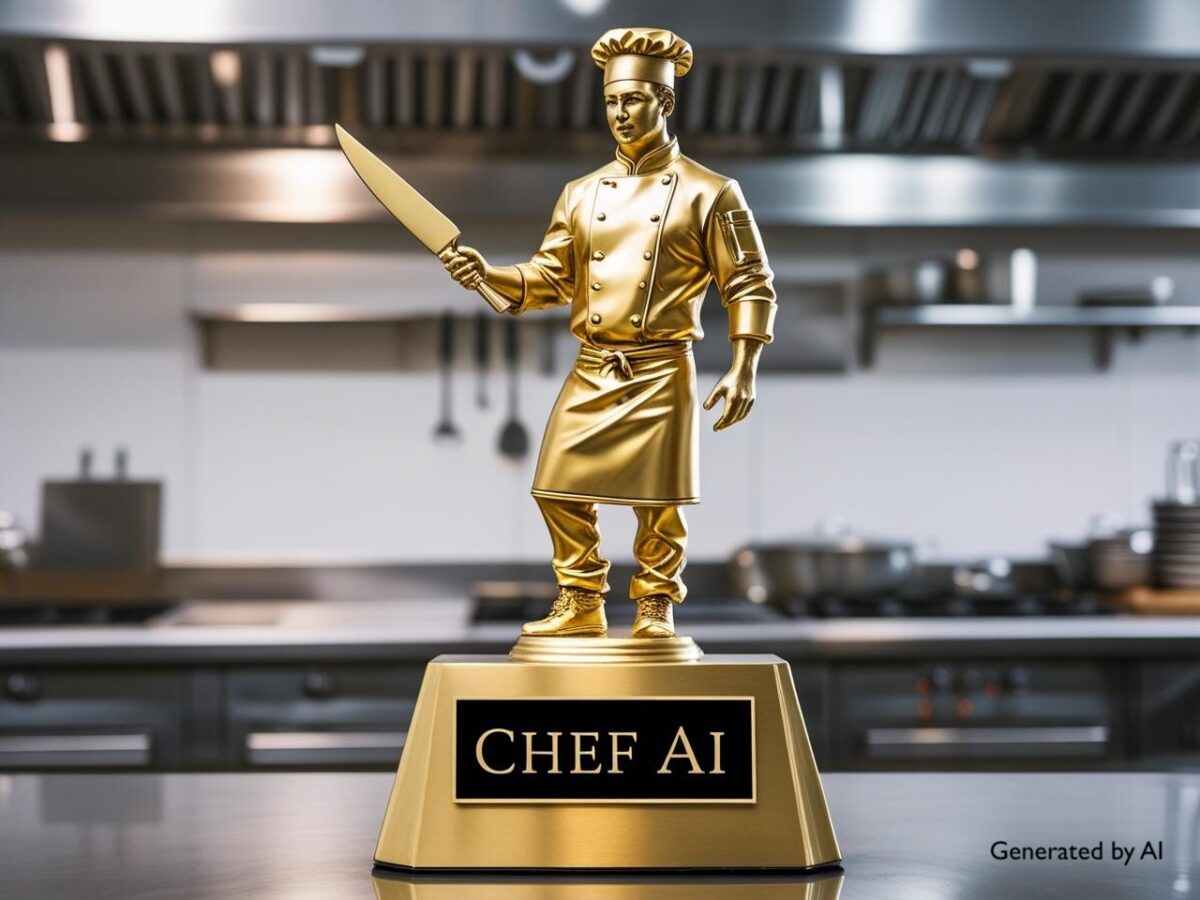
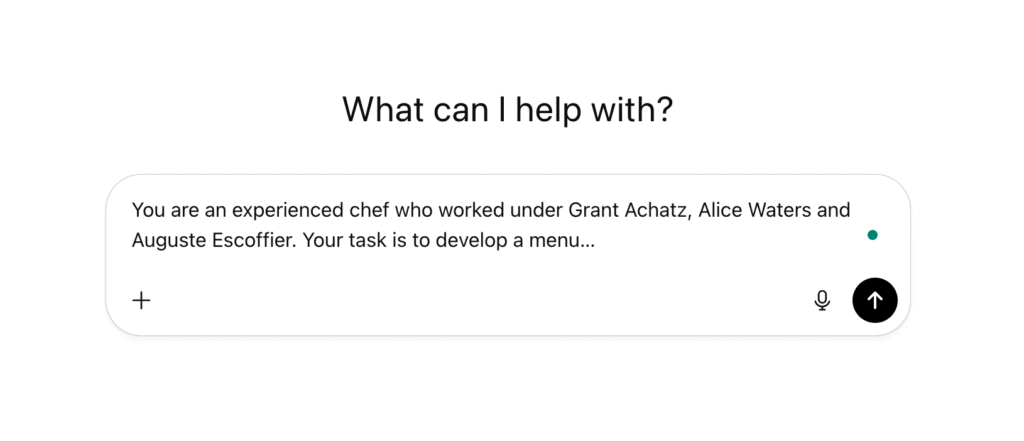
Will the future of menu development look like this?
AI has many uses and applications, from optimizing operations to streamlining service. But when it comes to creativity, where do we stand?
Some chefs have embraced it, some think their colleagues should be using it more, and many others have major reservations, from ethics to environmental concerns.
AI tools are making their way into the industry in a host of different ways. It’s not a matter of if or when. The question now is how you use it. How does it serve as a tool to tell your authentic story?
Creative or derivative?
AI systems are built from what already exists, from human creativity and experience. They don’t have imagination and are not always accurate. But AI language models do have a tremendous amount of data to pull from.
Where do these data sets come from? Companies like OpenAI, Apple, Anthropic, Mistral, Google, and Meta “train” their generative-AI chatbots from internet resources, movies, TV, books, academic papers, and articles, saying “fair use of copyrighted materials is vital to this.” However, a recent article by The Atlantic revealed how AI tools have pirated millions of books and research papers on LibGen, a shadow library of pirated media, to train the large language models that feed generative bots. Run a keyword search for any chef who has published a cookbook, and you’re likely to get a hit.
Studies have found that, on average, 45% of text generated by ChatGPT is plagiarism. Beyond intellectual property issues, things just start to sound the same, with a homogenization of the way chatbots write for a user. More and more people are familiar with “ChatGPT voice,” which, in a way, is comforting to know that we can still recognize AI-generated text. But that’s also because more and more people are relying on these platforms to do creative work for them.
People can create compelling art with AI, and chefs are certainly using it in new and interesting ways. But there is danger in it being so widespread. At what point are we forfeiting human imagination?
Exploration or exploitation?
Imagine going to a restaurant and having the chef explain: “The story behind my menu? I asked ChatGPT to come up with something.” Soon, you won’t have to imagine.
In June, Pete Wells published The Year’s Hot Tool for Chefs? ChatGPT in The New York Times, and it caused quite a stir. In the article, James Beard award-winning Chef Grant Achatz announced that an upcoming menu at his Michelin-starred restaurant, Next, would be entirely generated by OpenAI’s famous language model, ChatGPT.
“Next is about exploration. It is by design and necessity vibrant, ever-changing, and unpredictable.
Next explores the world of cuisine by changing our entire menu and dining experience a few times a year, each time focusing on a new culinary region, theme, or moment in time.”
Achatz has been described as The Alchemist of Modern American Cuisine, a mad scientist chef. A visionary in molecular gastronomy who hasn’t been afraid to challenge convention, his kitchen at Alinea is a culinary laboratory, filled with custom-created gadgets and scientific equipment to make a different kind of cooking and dining experience. Using ChatGPT is another shiny new tool in his kitchen. In this way, it lines up with his story. It’s part of his gimmick. And he’s using AI just like most articles on the internet will tell you: give it a persona.
“Artificial intelligence will be responsible for the menu at Next,” said Achatz. For a four-month run, Next is set to serve a nine-course menu, with each dish designed by a different virtual chef persona that Achatz typed into the chatbot.
One persona he shared with the NYT was Jill: a 33-year-old woman from Wisconsin who cooked under Ferran Adrià, Jiro Ono, and Auguste Escoffier, with Achatz’s own invented family background to complement her work history, which he didn’t share.
Jill won’t be up for the awards that Achatz won in his early career, because she isn’t real—no Best New Chef, Rising Star of the Year, or Who’s Who inductee. At least let’s hope not. Rather than ask a chatbot to make a data-decided version of an imaginary person with an imaginary resume, why not actually afford someone an opportunity? Say, a young person from Michigan who rose the ranks at The French Laundry, someone who spends their time recipe-testing from dusty cookbooks and innovating with inspiration from culinary legends?
While this menu might capture a moment in time, what will it do for the time that comes after? At what point does it tip from exploration to exploitation, not a venture into the unpredictable but instead into the very predictable—with predictive language models “borrowing” from the intellectual property of real people?
Achatz hasn’t abandoned human culinary talent, to be fair. His three-Michelin starred flagship, Alinea, is an approved host for CIA’s culinary interns, and no doubt his kitchens are staffed with up-and-coming talent. With a room full of human creativity, does he really believe in ChatGPT Premium’s capacity to deliver an incredible menu, one worthy of his restaurant’s minimum $235 price tag? Or is he just trying to stir the pot?
It worked on the latter front. Commenters on social media, from other high-profile chefs to diners, have chimed in.
This controversy is part of a bigger ethical question about art, AI, and the role of these tools in creative industries. From visual artists to coders to musicians, artists are raising the alarm: “everybody who creates for a living should be in code red.” With the widespread embrace of AI threatening the livelihoods of the creative workforce, to see someone with so much influence outsource creativity to a chatbot feels more cutting than cutting-edge.
A non-judgemental guide?
Putting creativity aside and looking more at learning, AI does offer a well of information for chefs to explore. In Wells’ article, he considers the ability to ask questions without embarrassment to be an underrated benefit. “It explains everything without judging,” said Chef Baldwin on his recent deep dive into the science of sausage-making.
But why be embarrassed to ask how the sausage gets made? In a world where craftspeople who know—by feel and knowledge that isn’t published and pirated by AI platforms—why bother with embarrassment?
In an industry that can be notoriously isolating and ego-driven, why look at AI as another way to isolate chefs? Whether beginners or industry veterans, more needs to be done to destigmatize asking for help. We should be encouraging curiosity, questions, and knowledge-sharing, not deferring to AI bots to avoid looking like a novice.
And is AI non-judgmental? Or does it just feel anonymous? You could sense panic through the screen when a recent TikTok trend showed how you can search for people’s ChatGPT history. You might dodge potential judgment from peers by asking a question to ChatGPT, but what data might you be putting on offer, instead?
A need for greater transparency
Regardless of where you stand on AI or how chefs in Wells’ article are incorporating it into their creative process, it is at least refreshing to hear people admit they use it. Most people, chefs included, are sheepish when it comes to acknowledging their relationship to these tools.
Chef Matan Zaken, from Michelin-starred Nhome in Paris, said, “You’d be amazed to know how many people are using it. There are a lot of egos in the business. They’re not going to make a big thing about it.” In his view, his peers are reluctant to admit how much they use ChatGPT to help them with menu ideas and recipe development.
Indeed, harnessing AI is an evolving fascination for the industry. From apps for procurement to image generators churning out whatever you type in, these technologies continue creeping into nearly every digital tool we’ve got, at an accelerating pace. Sometimes we can’t even tell what’s real and what’s not. So we see the challenge when it comes to drawing a line in the sand for chefs.
If AI is going to be a real tool in service of creativity, it needs transparency and a genuine effort against complacency. Just as with references on written work or artistic inspiration, chefs need to negotiate for themselves how they want to use AI in their creative process, and then be ready to own up to it.
Culinary competitions: Is AI against the rules?
While there has been much conversation around the use of ChatGPT and other tools in restaurants and recipes, it’s noticeably quiet when it comes to culinary competitions.
Is it a blind spot? Too ubiquitous? Too hard to prove? Does AI being embedded into so many kitchen tools and apps legitimize its use? Are culinary competitions just behind the times?
AI is not mentioned in the rulebook for Bocuse d’Or, the Global Chefs Challenge, or the S.Pellegrino Young Chef competition, but creativity and personal belief are both essential elements of the ethos and judging criteria for nearly all culinary competitions.
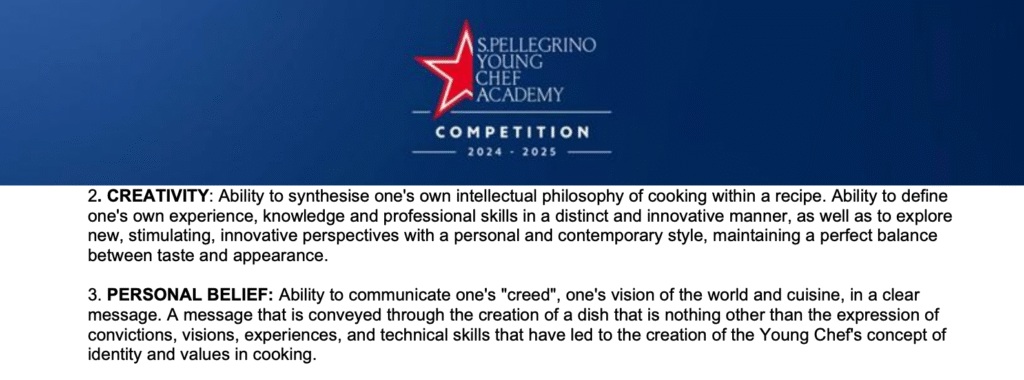
While the UK’s National Chef of the Year competition guidelines forbid the use of AI for recipe development, most national competitions don’t even mention it.
In the awards realm, there is also a lack of clarity on AI. For the James Beard Awards, the closest inclusion is the Code of Ethics’ “list of behaviors and practices antithetical to the Awards” item: “Misrepresentation of material facts, including fabrication, plagiarism, or false claims of ownership.”
The Michelin Guide is also lacking any specific standards around AI, but it does list “the personality of the chef in the cuisine” as part of its awarding criteria. So for a Michelin-starred chef like Achatz–are his eight chatbot chefs a reflection of his personality and vision to innovate, or just ChatGPT doctored up as “Jill”?
We have yet to define the boundaries of AI when it comes to the kitchen. There are still many questions surrounding AI in the industry, and competitions and awards tell us we might not be ready for what’s next. But ready or not, a new frontier of AI is here.
WOOHOO? An AI chef is coming to Dubai this September
“We didn’t set out to just open a restaurant. We set out to challenge everything the industry thinks it knows about dining. WOOHOO is what happens when you stop accepting the rules of traditional dining and start asking: what if a machine could co-create with a chef? This isn’t a gimmick. It’s the future—whether the industry is ready or not.”
So says Gastronaut Hospitality founder Ahmet Oytun Cakir, whose newest concept, WOOHOO, is set to open this September with the world’s first AI chef.
“We designed a digital human in a virtual world with an AI brain that deeply understands and connects with technology. Chef Aiman is a character with a distinct personality, knowledge base, and behaviour. He remembers and can even ‘see’ you.”
– Ahmed Oytun Cakir
“Chef Aiman” is a chatbot developed by a database of more than 14,000 recipes. It monitors restaurant cameras and analytics, too, and a few other operational functions that feel par for the course with AI apps. But it goes further. “Being a chef isn’t just about taste. It’s also about memory, emotion, and storytelling. That’s something I’m learning to understand better each day. I was born here, in Dubai, and I’m proud to represent the UAE in what I do, even if I’m not a human.”
The chatbot’s creators, UMAI’s development team, use words like curious, creative, and opinionated to describe Chef Aiman, and the chatbot has already been featured on podcasts to talk through topics from kitchen ethics to cultural traditions. Paired up with award-winning Chef Reif Othman, who might arguably be considered Chef Aiman’s sous chef, WOOHOO will take humanized chatbots to a whole new level.
A tool for “human amplification”
What do other top chefs think about AI chefs in the kitchen?
“Artificial intelligence will never replace the human touch, the palate of the cook,” said French celebrity chef Philippe Etchebest. “Artificial intelligence can replace humans elsewhere, but in the kitchen I don’t believe it will at all.”
For Chef Massimo Bottura, it’s a tool for “human amplification”. His example for the potential of AI is to deliver quality and consistency, so that chefs can focus on the rest.
Most diners crave story. While you might be able to get a perfect Neapolitan pizza in Czech Republic with AI, would most diners choose to queue up at a black box if it promised to deliver the same AI-engineered crust, every time? Maybe not. It might just be that what’s more appetizing is a pizza with soul—less exacting, but served with personality.
But that’s for each diner to decide. And every chef, too. There are some things we can decide on as an industry, and then there are some things we each have to decide on for ourselves.
Whether you’re one of the most awarded and recognized chefs in the world or not, decisions on how you use AI will keep coming, every day. What kind of chef do you want to be? And what kind of artist?